


Lung Cancer
Introduction
Receiving a lung cancer diagnosis is challenging. Right away, you are expected to make life-changing decisions. You want to make informed choices, but how can you when it all feels so urgent? Fortunately, you are now part of a team dedicated to providing you with the best care possible. The sharing of information among your health care team, support resources and you will be vital and may even lead to a more successful outcome.
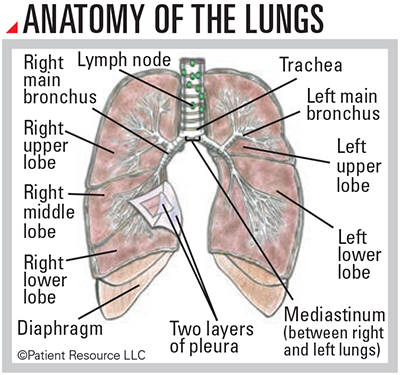
Facing uncertainty is easier once you understand your subject, so start with the basics. You have a pair of lungs in your chest cavity. They are large, spongy, expandable organs. The larger right lung has three lobes; the left lung has two. Both are surrounded by a thin layer of protective tissue called pleura.
How Lung Cancer Develops
Abnormal cells in the lining of the airways can accumulate and form a tissue mass. This is called a primary tumor. It may grow into the pleura, the thin layer of protective tissue that surrounds the lungs, and form secondary tumors nearby. These abnormal cells may also spread (metastasize) by entering the bloodstream and forming tumors (metastases or “mets”) in distant sites, such as the opposite lung, liver, brain or bones. Although these metastases are in other parts of the body, they are still considered lung cancer and are treated as such.
About NSCLC and SCLC
Lung cancer has two main pathologic types, which are identified by examining cells and tissues under a microscope: non-small cell lung cancer (NSCLC) and small cell lung cancer (SCLC).
- Adenocarcinoma is the most common NSCLC subtype, especially in people who have never smoked. It typically grows slowly and tends to spread to distant sites more often than other types, with the exception of SCLC.
- Squamous cell lung cancer (epidermoid carcinoma) is the second most common NSCLC subtype. It does not spread to distant sites as often as adenocarcinoma.
- Large cell carcinoma is the least common NSCLC subtype. It tends to grow and spread quickly.
SCLC is named because the cancer cells look small and oval-shaped when viewed under a microscope. It is an aggressive lung cancer and most often spreads to distant parts of the body before it is found.
Get and Stay Involved
Your education begins at diagnosis and will continue throughout your care. Ask your health care provider to explain your specific subtype of lung cancer. Learn more about it from your health care team and reliable resources, such as this guide and GO2 for Lung Cancer. The materials and websites you use should be easy to follow, not filled with medical jargon that further complicates your understanding of this complex cancer.
Weigh the information you learn with what is most important to you and your family in terms of quality of life. For example, find out if you can be treated close to home or if you will have to travel. Ask about potential treatment side effects that may occur and how to manage them. Learn from others who have had lung cancer. Their wisdom is helpful and encouraging.
Along with using reputable resources, you can help make your treatment more successful by attending all of your medical appointments, maintaining a healthy lifestyle and taking your medications as prescribed, even when you feel well and do not think you need them.
Lastly, keep the lines of communication open. When your health care team does not hear from you, they assume all is going according to plan. Continue to ask questions and never hesitate to ask for clarification if something is difficult to understand.
Uncertainties will exist with every illness, but being educated is empowering.
Using the Patient Portal
A patient portal is an easy way for you and your health care team to communicate outside of an office visit. It is convenient and helps you stay informed and involved in managing your health.
This secure website and/or phone app gives you 24-hour access to your current and past health information, including medications and test results. Many portals offer the ability to securely message the health care provider, request prescription refills, schedule non-urgent appointments, update contact information, download and complete forms, receive email reminders and alerts, and more.
The online portal is a valuable tool, but it should not be used for urgent issues or in place of seeing your health care provider in person. And, be aware that you may be able to view test results before your provider has a chance to discuss them with you. So, although you are anxiously awaiting your results and are likely checking the portal frequently, your health care provider has certain times set aside to review patient information. Try to be patient.
Ask your health care team if they offer a portal. If so, they will provide you with instructions for setting it up, and you will choose a secure username and password. Privacy and security safeguards are in place to protect your information.
