

Fertility Issues
Being a parent may be part of your life plan. Because cancer and its treatments can affect your fertility, making your treatment team aware of your life goals needs to happen before any treatments are considered. Ask about the risk of fertility issues from each type of treatment you are considering and the preventive measures that are available.
Females: For a woman to become pregnant naturally after cancer treatment, she must have at least one healthy ovary to produce the egg, one healthy fallopian tube through which the egg travels, a healthy uterus for the baby to grow, and correct levels of certain hormones that help maintain the pregnancy. An absence or imbalance of any these factors can lead to fertility problems after cancer treatment.
Males: Men who are unable to produce or ejaculate healthy sperm are technically considered to be infertile.
What causes fertility issues?
Drug therapies, radiation therapy and surgery can cause fertility issues. The endocrine glands and related organs release hormones that control fertility. When cancer or cancer treatments, such as certain drug therapies, surgery or radiation therapy, damage one of these glands or organs or alter the area of the brain that controls the endocrine system, fertility challenges can occur.
Females: In some cases, the effects of various therapies may be reversible, with function returning gradually over a few months or even years after treatment has ended. Ovarian shielding (placing external shields over the ovaries during radiation therapy to minimize exposure and damage) and ovarian suppression (taking a medication that causes the ovaries to temporarily shut down during chemotherapy) may be options. Loss of function is permanent when reproductive organs are surgically removed.
Males: The effects of some cancer treatments on the testicles can sometimes be reversible, although it isn’t typical. Regaining full sexual function after treatment may take time, mostly because both psychological and physical factors are involved. Loss of function is permanent if these organs have been surgically removed or altered.
How you can manage fertility issues.
Address the emotions that come with fertility problems. Consider counseling (individual, couples and/or sex therapy), talking with a spiritual advisor and physical exercise, which can help lower your stress surrounding this situation. Adoption is an option. Get in touch with an adoption attorney or agency to learn more. Some agencies are more open than others about working with cancer survivors.
Females: Your health care provider may be able to prescribe medication to help stimulate ovulation; however, this type of treatment is usually only beneficial to women whose infertility is due to problems with ovulation. Learn more about the fertility alternatives that are available, including assisted reproductive technologies (ART), such as intrauterine insemination (IUI), in vitro fertilization and third-party-assisted ART. If you were unable to preserve your fertility before treatment, third-party-assisted ART involves the use of sperm donors, egg donors and/or surrogates. A combination of treatments may be your best option. You may be able to use in vitro fertilization with donor eggs or have your frozen embryos carried to term using a surrogate. Talk to a fertility specialist about your options.
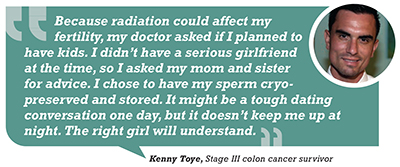
Males: If you didn’t pursue the use of sperm banks, testicular sperm extraction or gonadal shielding prior to radiation therapy, little can be done to reverse the effects afterward. Donor insemination (using sperm from someone you know or from a stranger) is a possibility. The semen is then used to create a pregnancy via intrauterine insemination (IUI).
When to talk to your health care provider about fertility issues.
Because fertility issues often arise as soon as treatment begins, it is essential to talk to your oncologist and a fertility specialist before starting treatment. Options for preserving your fertility become much more limited after treatment starts. If you and your partner have been actively trying to conceive for a year after treatment ends but are unsuccessful, ask your health care provider or fertility specialist for referrals to help you explore other possibilities.
